

Liquid until it’s not: what AIFMD II expects from your liquidity framework
On paper, a portfolio can look perfectly liquid. Every position has a price, every fund has a dealing calendar, and redemptions have always been met on time. But liquidity is not a fixed property of an asset; it is a condition of the market at any single moment and can deteriorate suddenly. A security that trades actively today may become less liquid tomorrow, with prices updating less frequently, bid-ask spreads widening, and trading volumes declining, making transactions both costlier and slower to execute.
Closing the gap between how liquid a book looks and how liquid it proves to be under stress is precisely what the current wave of regulations asks fund managers to do.
More, more, more
AIFMD II raises expectations on portfolio-liquidity monitoring and the availability and governance of Liquidity Management Tools (LMTs). The framework was applied from 16 April 2026 for newly launched funds, while funds already in existence have until 16 April 2027 to bring their monitoring and governance practices into line. It has also widened the catchment: the liquidity risk management requirements now apply beyond traditional asset managers to loan-originating funds and other vehicles exposed to less liquid assets.
Across Europe and the UK, supervisors including ESMA and the FCA among them are converging on the same direction of travel: more granular monitoring, more evidence, more often. Selecting tools and updating fund documentation was the first step; the harder phase is turning the selected tool into a solution that actually works on a dealing day, with the data to support it.
Selecting the tools isn’t the hard part
LMTs are the mechanisms that protect a fund and its remaining investors when flows turn disorderly. Regulators divide them into mandatory and optional tools and expect managers to hold a combination appropriate to each fund’s structure.
- Side pockets isolate illiquid or distressed assets from the main portfolio, so that investors leaving the fund cannot take the liquid assets and leave the illiquid ones behind for those who remain.
- Redemption gates cap the share of redemptions executed on a single dealing date once a threshold is breached, deferring the excess to later dates to avoid forced sales that would hurt remaining investors.
- Dual pricing and swing pricing adjust subscription and redemption prices — or the NAV itself — so the cost of trading is borne by the investors who transact, not by the ones who stay invested.
Selecting the tools is the straightforward part. Calibrating them is where frameworks are tested, and where expectations have most increased. It is increasingly expected that thresholds and factors be justified by analysis rather than set by convention and reflect the size and timeframe of an actual liquidation.
The reasoning is straightforward. A swing factor that does not reflect the true cost of liquidating the underlying assets, or a gate threshold set without a clear view of the fund’s redemption coverage, is governance on paper rather than protection in practice.
In practice, three questions tend to separate a framework that would hold from one that has never been tested:
- Could you show how a swing factor or gate threshold was derived, and when it was last reviewed?
- If liquidity in a significant holding deteriorated this week, how and when would you know?
- During a severe outflow, do you know what shortfall would remain, and could you evidence it to your board?
A portfolio that looks liquid but isn’t carries a real cost. Assessing liquidity properly means looking past the quoted price to understand the real cost and timing of getting out. Modern liquidity analytics combine market-data indicators such as trading volumes, bid-ask spreads, liquidity scores, dealing frequencies and market depth — into metrics such as Time-to-Liquidate and Time-to-Settle. This calculates how quickly a position could be unwound without moving the market against you, measured at both instrument and portfolio level and allowing for contagion across holdings.
Under stress, those numbers may move in an unfavorable direction. Liquidation costs rise, execution takes longer, and the trade that looked cheap in a calm market becomes expensive in a volatile one. Conditions can change within a single trading session, which means a framework refreshed on a quarterly reporting cycle will describe the market as it was rather than as it is. A framework that only measures liquidity in normal conditions is, in effect, not enough.
The moment that matters
All of this is tested at one particular moment: when redemptions roll in. Under stress they rarely land one at a time. They cluster, they accelerate, and they tend to coincide with exactly the conditions in which assets are hardest to sell.
The question is therefore not simply whether a fund can meet redemptions, but whether it can meet them in full, on time, and without disorderly sales that impact the investors who remain. Answering that requires firms to model the liabilities side as carefully as the assets: redemption coverage against available liquidity, the shortfall that would remain under a severe outflow, the concentration of the investor base, and what a partial or stressed redemption scenario would actually look like.
It is also the point at which evidence matters most. Boards, investors and supervisors are less interested in whether a manager feels confident than in whether that confidence can be backed up with numbers, scenarios and a documented basis for the decisions taken.
A capability, not a checkbox
The firms that navigate the next period of market stress will be the ones that treat all of this as a capability to build, not a box to tick. In practice, a resilient liquidity framework runs on four components working together:
- Monitoring — instrument-level liquidity analytics, aggregated to the portfolio and refreshed often enough to be useful when conditions change.
- Stress testing — portfolio-level testing across normal, stressed and severely stressed conditions, on both the asset and the liability side.
- Liquidation tools — the LMTs themselves, calibrated from data rather than convention, and operationally ready to apply.
- Governance — clear ownership, documented methodology, defined escalation, and reporting that reaches the people who make decisions
Together, these move liquidity risk from something a fund reports on to something it can act on — and a way to demonstrate to a board, an investor or a regulator, that it can meet redemptions without harming the investors who remain.
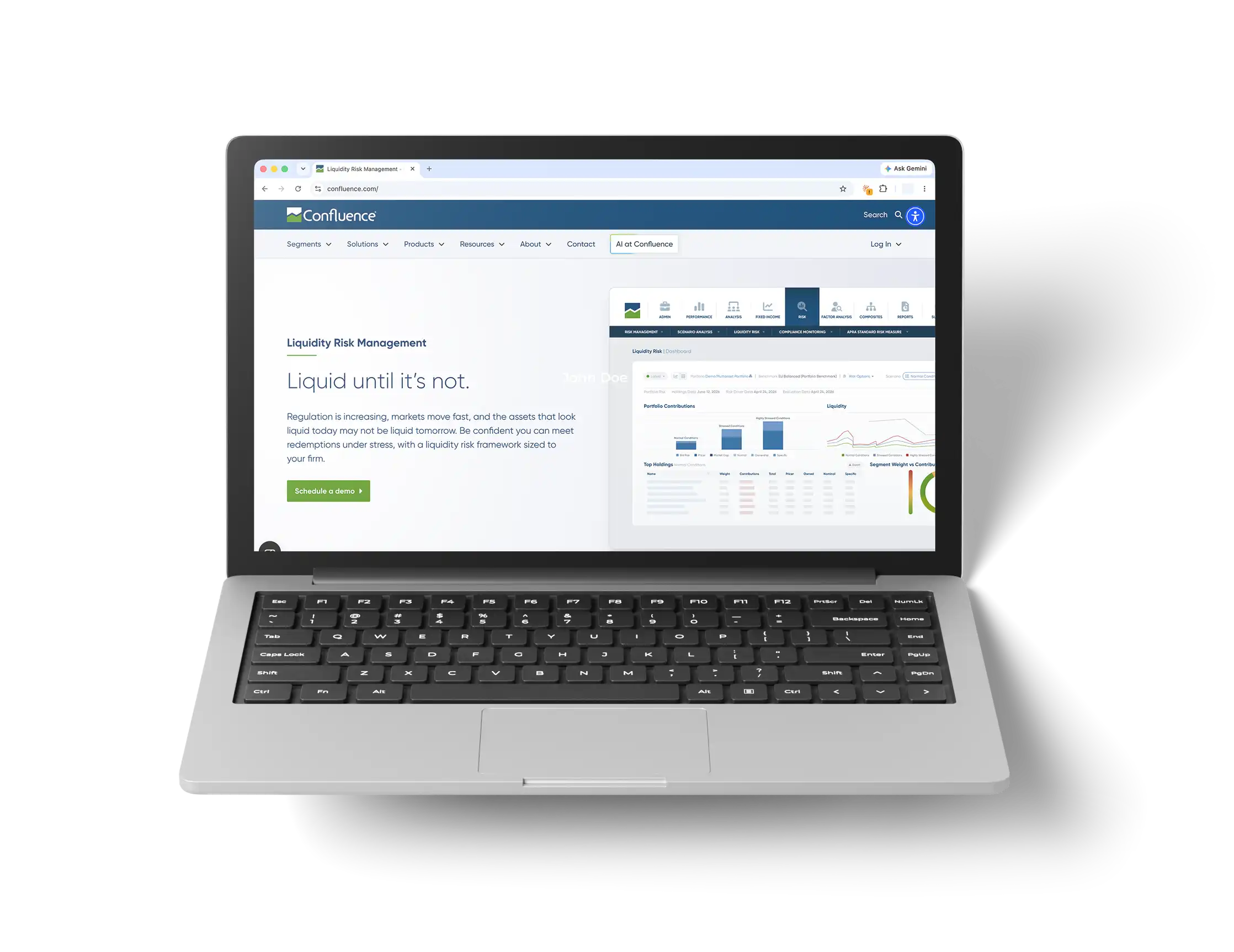
Confluence Revolution supports all four. Its liquidity capability spans:
- instrument-level liquidity scoring and monitoring;
- portfolio stress testing across normal, stressed and severely stressed conditions;
- redemption and liabilities scenario analysis, including cover ratios and shortfall;
- the liquidity management tools themselves, from side pockets and redemption gates to anti-dilution pricing
ESMA laid the analytical groundwork when it introduced its liquidity stress testing guidelines and built on this for AIFMD II. Firms already using Revolution are therefore adapting an existing framework rather than building a new one against a deadline.
AIFMD II is less a new rulebook than a higher bar on for an existing rule. For fund managers, the practical question is no longer whether liquidity is being managed, but whether the framework behind it would hold the first time the market tests it. Ahead of the April 2027 deadline, see how Confluence helps fund managers monitor liquidity, stress test portfolios, calibrate their liquidity management tools and evidence the decisions behind them.
Moving from regulation to readiness
Understanding the requirements is only the first step. Discover how firms are responding to evolving liquidity risk management expectations and building more resilient frameworks for the future
Disclaimer
The content provided by Confluence Technologies, Inc. is for general informational purposes only and does not constitute legal, regulatory, financial, investment, or other professional advice. It should not be relied upon as a substitute for specific advice tailored to particular circumstances. Recipients should seek guidance from appropriately qualified professionals before making any decisions based on this content.
Unless otherwise stated, Confluence Technologies, Inc. (or the relevant group entity) owns the copyright and all related intellectual property rights in this material, including but not limited to database rights, trademarks, registered trademarks, service marks, and logos.
No part of this content may be adapted, modified, reproduced, republished, uploaded, posted, broadcast, or transmitted to third parties for commercial purposes without prior written consent.
About Confluence® Technologies
Confluence is a leading provider of specialist regulatory, analytics, and investor communication solutions for asset managers, asset servicers, investment consultants, and asset owners. Across performance, risk and peer analytics, regulatory filings and compliance monitoring, and shareholder reporting and document production, firms depend on Confluence for output they trust. We deliver this through deep domain expertise and purpose-built products developed over decades of research and engineering.
Confluence solutions are powered by Confluence POINT, AI-enabled automation that runs within and alongside Confluence’s trusted solutions. POINT optimizes inefficient workflows, delivering a meaningful impact on outcomes without requiring significant operational change.
Headquartered in Pittsburgh, PA, with 750+ employees in 15 offices across the United Kingdom, Europe, North America, South Africa, and Australia, Confluence services over 1,000 clients in more than 40 countries. For more information, visit www.confluence.com.
Confluence Media Contact:
Jon Schubin
Cognito