

The people behind the analytics: Denis Costa and Lara Evans

In this instalment, we speak to Denis Costa, Principal Solutions Consultant and Lara Evans, Senior Implementation Consultant, Composites in our Client Experience team. They have each spent over 17 years in the industry working on performance measurement and attribution, GIPS composites and reporting. Here is what they see in this market.
Performance, risk and attribution are not explained by software alone. The people who understand what the numbers are saying play an essential role. In the people behind the analytics series, we speak to the Confluence® experts who do just that across South Africa, working with the investment firms and service providers we serve.
We put five questions on performance, risk and attribution in South Africa to members of our local analytics team. Each conversation covers the challenges investment firms and service providers face, where they see analytics break down, and what becomes possible with the right set up?
Q: What is the most common question you are asked in your work with clients?
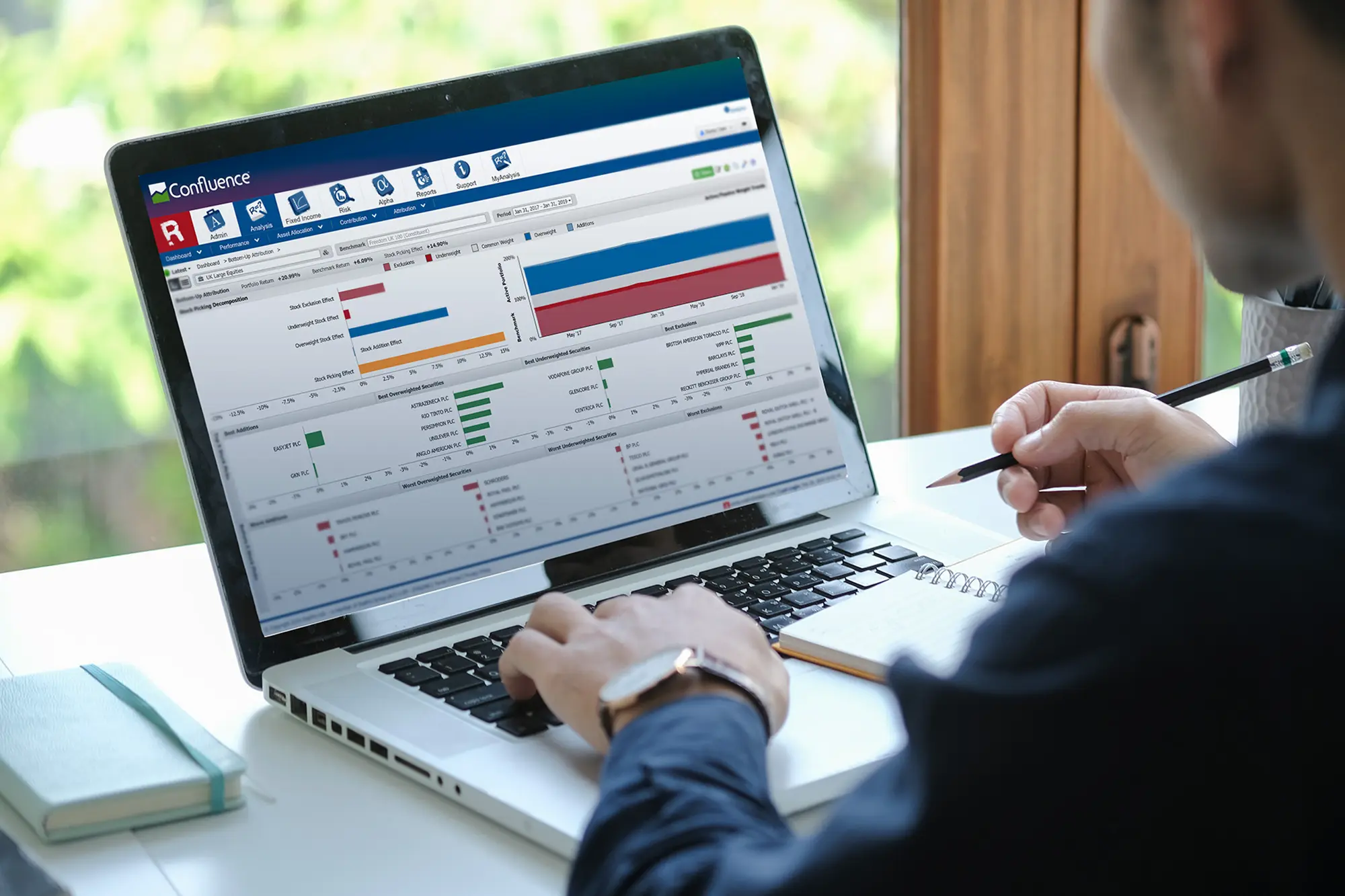
A: A lot of our client conversations begin with a variation of the same question: “What is the most effective way to achieve this in Revolution?”
Clients generally know the outcome they are after. What they want from us is our experience of Revolution and of working with other investment firms, so they can identify the right approach to achieve that goal. That might mean structuring a calculation, bringing additional data into Revolution, designing a workflow, or producing a specific output.
As most of our local clients have recently moved from our legacy product to Confluence Revolution, we’re investing significant time understanding what the client is really trying to achieve, then determining the most effective way to deliver it in Revolution.
Sometimes that means recreating a process the client already has. Often, it is a chance to simplify the process and remove steps that are no longer needed.
The aim is to leave the client with Revolution configured around the right data, calculations and processes for their needs today, and a solution that can evolve as those needs change.
Q: What are South African asset managers and asset owners focused on right now, and how is that shaping the analytics they need?
A: A major focus is getting more value and efficiency from the technology and data they already have.
Once clients have completed the move from our legacy product to Revolution, the conversation shifts from the migration to what they can now do differently or better. The value of a migration goes beyond simply having a newer solution. It lies in improving how analytics are produced, accessed, and used across the business.
We are spending more time with clients on new and evolving requirements, ensuring the necessary data is available in Revolution and exploring how newer functionality can simplify workflows, automate repetitive processes and speed up the delivery of results.
AI is increasingly part of those conversations. Clients are looking at how they can use AI to analyze information, improve reporting and reduce manual work. They are keen to see how it can work with the trusted data and analytics already in Revolution, whether that means interrogating results, identifying exceptions, producing commentary or simply getting to the information they need faster.
For us, the key point is that the underlying data and calculations remain controlled and reliable. AI is far more useful when it works from a trusted source of data than from fragmented or inconsistent information.
Q: What is the most common mistake you see in how firms handle performance or risk, and what would side-stepping that unlock?
A: The most common mistake is carrying every old process forward without asking why it exists.
It is a natural instinct. When a team has trusted a process for years, the tendency is to reproduce it. The better question is: does this process still need to work this way?
Over the years, clients have built workarounds for their systems. Spreadsheets, scripts, and separate processes become woven into the fabric of how they work. Some workarounds consume a great deal of time, and the person who built them has often moved on, so nobody is quite sure how they work. Everyone just accepts they have to run.
When we come across these, we take a step back and ask whether the workaround is still needed at all. Quite often, Revolution now has a feature that does the same job in a cleaner, more controlled way, so we can retire the workaround instead of migrating it. You can almost feel the client’s relief when something that has been fragile or time-consuming for years simply disappears, replaced by functionality supported natively in Revolution.
That is why we focus on the purpose behind a process, not simply replicating it. Moving away from a straight “lift and shift” can remove a surprising amount of manual work and complexity, leaving clients with performance and risk processes that are easier to maintain.
Q: What is the biggest change you have seen in how investment firms measure and explain performance and risk, and what do you see coming next?
A: One of the biggest changes is the move from periodic reporting to faster access to more detailed information.
Clients no longer want only a standard set of reports at the end of each reporting cycle. They increasingly want the underlying data, so they can answer new questions quickly, investigate exceptions, and respond to requests without building a new manual process each time.
That changes what we need to deliver. Producing a correct performance or risk number is no longer enough. The data must also be structured and accessible, so clients can ask different questions as their requirements change.
The next step is greater automation and AI, and that is already under way. Clients are experimenting with AI in their own businesses, and Confluence is embedding AI across our solutions. Confluence® POINT™Prompt is an AI-enabled conversational interface for Revolution in Excel. Users ask a question in plain English within Excel, and POINT retrieves the answer from Revolution and returns it to the worksheet, with no switching between systems or exporting.
AI won’t remove the need for specialist performance and risk. Revolution is a specialist engine that has been built over decades of research and engineering. The opportunity with AI is to make using these specialist solutions easier, and to reduce manual effort that still resides either side of automation. This then allows more time for understanding, challenging and explaining what the numbers actually mean.
Q: Describe a client problem you enjoyed solving. What made it interesting?
A: The problems we most enjoy solving are often those that reside in everyday processes that consume a client’s time.
Sometimes we uncover these problems during a migration, as we work through the client’s existing processes in detail. Other times, they become obvious later, as clients use Revolution more extensively and spot ways to improve how they work. They are not always the biggest projects, but they are often the ones where the difference is most noticeable to the people using the solution.
We have had clients tell us that a report that used to take almost a full day can now be completed in around 30 minutes. In another case, the legacy system had to be recalculated over an entire weekend, during which users effectively could not use it. In Revolution, the same process takes around an hour.
The real benefit is what clients can do with the time they get back. With Revolution handling the workflow, instead of spending perhaps 90% of their time managing it and only 10% on the result, they can spend far more of it reviewing the analysis, examining exceptions and understanding what the numbers are telling them.
That is where the value is. When we remove the manual effort and the process almost disappears into the background, the analysis becomes more useful.
The real benefit is what clients can do with the time they get back.
Denis Costa, Principal Solutions Consultant and Lara Evans, Senior Implementation Consultant, Composites
Disclaimer
The content provided by Confluence Technologies, Inc. is for general informational purposes only and does not constitute legal, regulatory, financial, investment, or other professional advice. It should not be relied upon as a substitute for specific advice tailored to particular circumstances. Recipients should seek guidance from appropriately qualified professionals before making any decisions based on this content.
Unless otherwise stated, Confluence Technologies, Inc. (or the relevant group entity) owns the copyright and all related intellectual property rights in this material, including but not limited to database rights, trademarks, registered trademarks, service marks, and logos.
No part of this content may be adapted, modified, reproduced, republished, uploaded, posted, broadcast, or transmitted to third parties for commercial purposes without prior written consent.
About Confluence® Technologies
Confluence is a leading provider of specialist regulatory, analytics, and investor communication solutions for asset managers, asset servicers, investment consultants, and asset owners. Across performance, risk and peer analytics, regulatory filings and compliance monitoring, and shareholder reporting and document production, firms depend on Confluence for output they trust. We deliver this through deep domain expertise and purpose-built products developed over decades of research and engineering.
Confluence solutions are powered by Confluence POINT, AI-enabled automation that runs within and alongside Confluence’s trusted solutions. POINT optimizes inefficient workflows, delivering a meaningful impact on outcomes without requiring significant operational change.
Headquartered in Pittsburgh, PA, with 750+ employees in 15 offices across the United Kingdom, Europe, North America, South Africa, and Australia, Confluence services over 1,000 clients in more than 40 countries. For more information, visit www.confluence.com.
Confluence Media Contact:
Jon Schubin
Cognito