

Client demands and regulatory mandates in the investment management industry show no signs of slowing down in the years ahead. Thriving in this shifting landscape means asset managers need to create meaningful composites which are essential in the fair presentation, consistency, and comparability of performance over time and among firms.
To achieve this firms need to unlock the advantages of composites and the GIPS® Standards which can help firms simplify compliance with other current and future rules, gain more trust from prospects and clients, and maximize marketing and sales efforts.
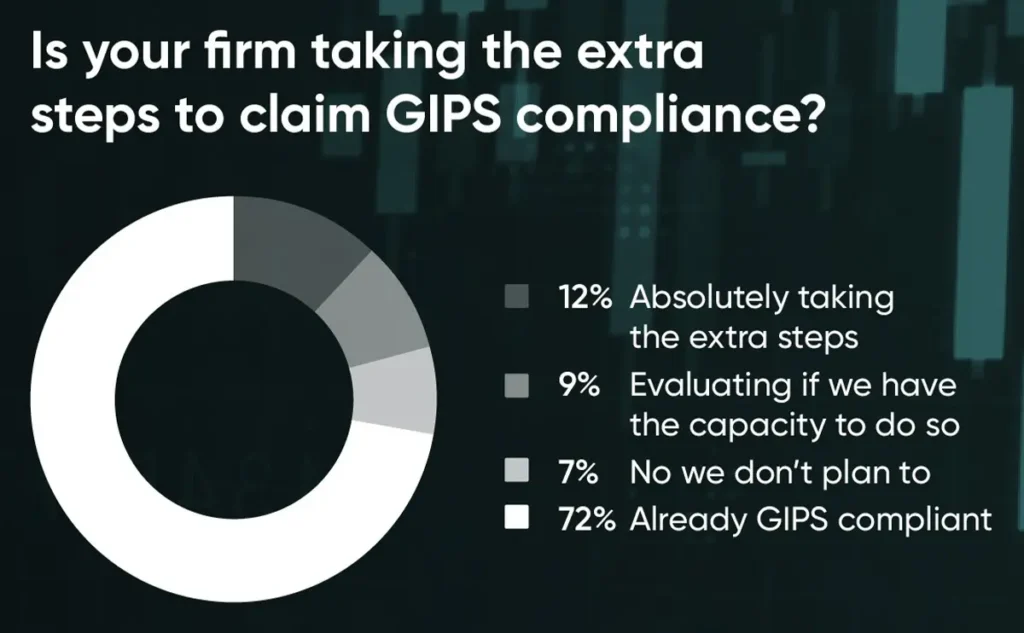
During a recent webinar, we asked attendees if they were taking the extra steps to claim GIPS compliance. Here are the results:
However a fair amount of financial and human resources is required for firms to achieve GIPS compliance. The GIPS standards include several concepts where technology can play a larger role. Following are some examples of areas in which technology can be readily used to eliminate or minimize manual tasks and replace them with automated processes.
Allocating cash for carve-outs
These are used to create a track record for a narrower mandate from a multi-strategy or multi-asset-class portfolio managed to a broader mandate. For example, a firm might wish to carve out the small-cap portion from a domestic equity portfolio.
For carve-outs that are not managed with their own cash, firms are allowed to synthetically allocate cash to them, but must do so for all relevant portfolios across the firm. Technology can help firms save time and money by automating these complex data collection and calculation exercises.
Calculating different net returns for pooled funds
Firms may calculate net returns for an individual pooled fund and present them in a GIPS Pooled Fund Report that includes the performance of only that fund. A pooled fund net return must reflect the deduction of all fees and expenses charged to the pooled fund, including transaction costs, investment management fees and administrative fees. This is a NAV-based return.
However, net returns for pooled funds included in a composite will differ. Those net returns must reflect the deduction of transaction costs and investment management fees, but not administrative fees. Technology can assist with calculating multiple return streams for a single fund.
Applying model investment management fees
When calculating composite net-of-fee returns, a firm may use either actual or model investment management fees. The same is true for pooled funds. Model fees are widely used, and many firms today are still doing these calculations manually via spreadsheets.
Calculating and applying estimated transaction costs
All returns must be calculated after the deduction of transaction costs incurred during the period. The firm must use estimated transaction costs for those portfolios for which actual transaction costs are not known. Technology can help to drive higher accuracy and efficiency in the preparation and application of these estimates.
Automating money-weighted return calculations
The GIPS standards introduce flexibility around the more relevant use of money-weighted returns (MWRs) versus time-weighted returns (TWRs). With this new flexibility, firms have a better pathway to become GIPS compliant and automate this process, which anecdotal evidence indicates is today primarily done manually with spreadsheets.
In addition to increasing your firm’s credibility by complying with GIPS, technology can help promote greater operational cohesion. Failures in data control and operational risk can be mitigated with a solution that can streamline the calculation, creation and maintenance of composites and provide more efficient reporting to external auditors and clients.
Disclaimer
The content provided by Confluence Technologies, Inc. is for general informational purposes only and does not constitute legal, regulatory, financial, investment, or other professional advice. It should not be relied upon as a substitute for specific advice tailored to particular circumstances. Recipients should seek guidance from appropriately qualified professionals before making any decisions based on this content.
Unless otherwise stated, Confluence Technologies, Inc. (or the relevant group entity) owns the copyright and all related intellectual property rights in this material, including but not limited to database rights, trademarks, registered trademarks, service marks, and logos.
No part of this content may be adapted, modified, reproduced, republished, uploaded, posted, broadcast, or transmitted to third parties for commercial purposes without prior written consent.
About Confluence® Technologies
Confluence is a global leader in enterprise data and software solutions for regulatory, analytics, and investor communications. Our best-of-breed solutions make it easy and fast to create, share, and operationalize mission-critical reporting and actionable insights essential to the investment management industry. Trusted for over 30 years by the largest asset service providers, asset managers, asset owners, and investment consultants worldwide, our global team of regulatory and analytics experts delivers forward-looking innovations and market-leading solutions, adding efficiency, speed, and accuracy to everything we do. Headquartered in Pittsburgh, PA, with 700+ employees across North America, the United Kingdom, Europe, South Africa, and Australia, Confluence services over 1,000 clients in more than 40 countries. For more information, visit www.confluence.com.