

Although portfolio management has traditionally been a male-dominated industry, there is strong evidence suggesting that historically, funds managed by women have outperformed those managed by men. A study by Goldman Sachs found that 48% of female-managed funds outperformed the market during a specific period, compared to only 37% for all-male funds.
Women-led funds also demonstrated greater resilience during market downturns, despite there being limited representation of women in the marketplace.
Over the years, research has consistently shown no inherent performance advantage based on gender in fund management. Despite these overwhelming facts, only 12% of portfolio managers are women.
Women are grossly underrepresented
As of December 2023, the proportion of female portfolio managers globally stood at 12.1 percent, marking just a slight increase from the previous year’s 11.9 percent.
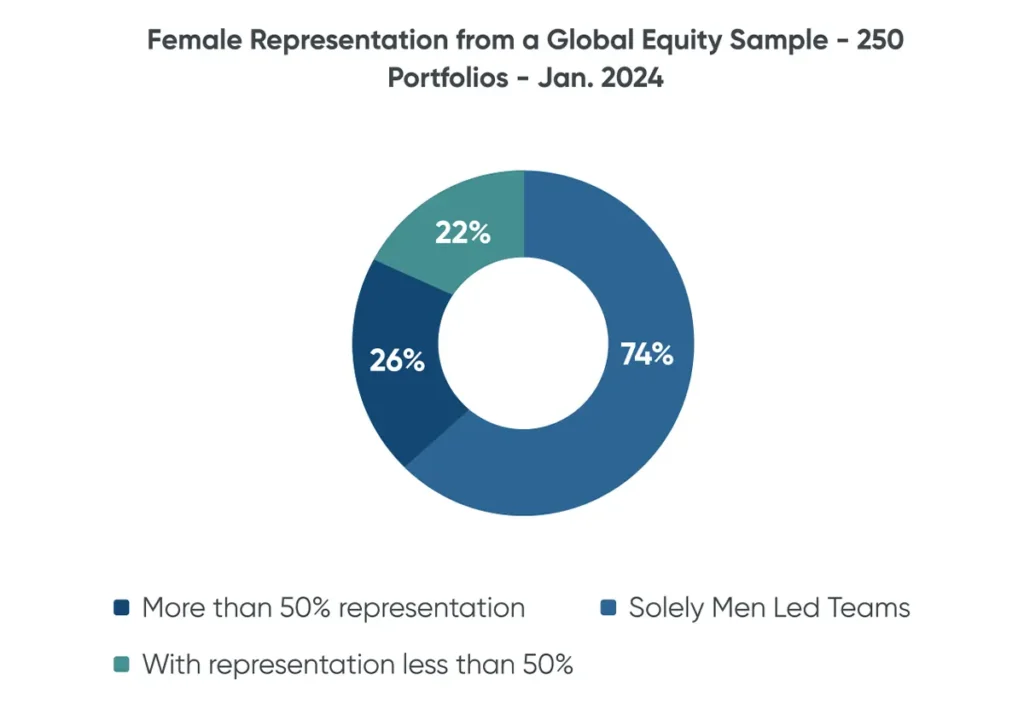
What factors contribute to the sluggish growth of female representation in the industry? We identified some reasons for this underrepresentation.
Culture
The culture and perception surrounding asset management pose significant challenges in both the attraction and retention of women employees. In certain sectors of the industry, there may exist an atmosphere marked by aggressive cultures, where an employees’ productivity or commitment is often judged by the hours spent in office. However, this has not deterred the legal industry, known for being high pressure environments. 52% of lawyers are women1.
Perhaps it is because of the deep-rooted cultural stereotypes that often associate men with financial acumen and risk-taking, while women are perceived as more risk-averse. These biases can affect hiring decisions and career progression.
Flexible Working
Challenges in implementing flexible work arrangements have also been recognized as another major factor in contributing to low representation of women in senior financial services positions. It is often hard for portfolio managers to take extended breaks of several months or years for caregiving responsibilities, gaps in the track record can be seen as detrimental to one’s career.
Talent Retention
The industry continues to face challenges in retaining skilled women. With the preference towards stability and reliability, firms are typically prompted to retain managers who have served for extended periods. With the predominant male presence in portfolio management, this leads to “tenure bottleneck” hindering the enhancement of gender balance.
Stereotypes on Risk Aversion
Widespread assumptions about women’s high-risk aversion can impede their ascent to leadership positions in portfolio management. Stereotypes about women’s cautiousness and aversion become hurdles in acquiring roles that require risk-taking and decision-making.
A well-diversified portfolio can only be achieved by a diversified team of individuals. Ultimately, portfolio management with a gender lens approach, is a proven mechanism for the genuine beneficial of the industry, however, more efforts are required to establish an inclusive and equitable environment.
Networking and Mentorship
Historically, men have dominated networking circles within the finance industry. Access to mentorship, sponsorship, and networking opportunities is crucial for career advancement. Women may face challenges in building these connections. The scarcity of visible female role models in portfolio management can discourage young women from pursuing careers in finance. Representation matters, and having successful female leaders can inspire others to follow suit.
Change is Necessary
Historically, men have dominated networking circles within the finance industry. Access to mentorship, sponsorship, and networking opportunities is crucial for career advancement. Women may face challenges in building these connections. The scarcity of visible female role models in portfolio management can discourage young women from pursuing careers in finance. Representation matters, and having successful female leaders can inspire others to follow suit.
1 https://www.zippia.com/advice/what-percentage-of-lawyers-are-female/
Disclaimer
The content provided by Confluence Technologies, Inc. is for general informational purposes only and does not constitute legal, regulatory, financial, investment, or other professional advice. It should not be relied upon as a substitute for specific advice tailored to particular circumstances. Recipients should seek guidance from appropriately qualified professionals before making any decisions based on this content.
Unless otherwise stated, Confluence Technologies, Inc. (or the relevant group entity) owns the copyright and all related intellectual property rights in this material, including but not limited to database rights, trademarks, registered trademarks, service marks, and logos.
No part of this content may be adapted, modified, reproduced, republished, uploaded, posted, broadcast, or transmitted to third parties for commercial purposes without prior written consent.
Author

About Confluence® Technologies
Confluence is a global leader in enterprise data and software solutions for regulatory, analytics, and investor communications. Our best-of-breed solutions make it easy and fast to create, share, and operationalize mission-critical reporting and actionable insights essential to the investment management industry. Trusted for over 30 years by the largest asset service providers, asset managers, asset owners, and investment consultants worldwide, our global team of regulatory and analytics experts delivers forward-looking innovations and market-leading solutions, adding efficiency, speed, and accuracy to everything we do. Headquartered in Pittsburgh, PA, with 700+ employees across North America, the United Kingdom, Europe, South Africa, and Australia, Confluence services over 1,000 clients in more than 40 countries. For more information, visit www.confluence.com.