
The impact of tariffs on the market: Lessons from 2018-2019 and what it means for Trump 2.0
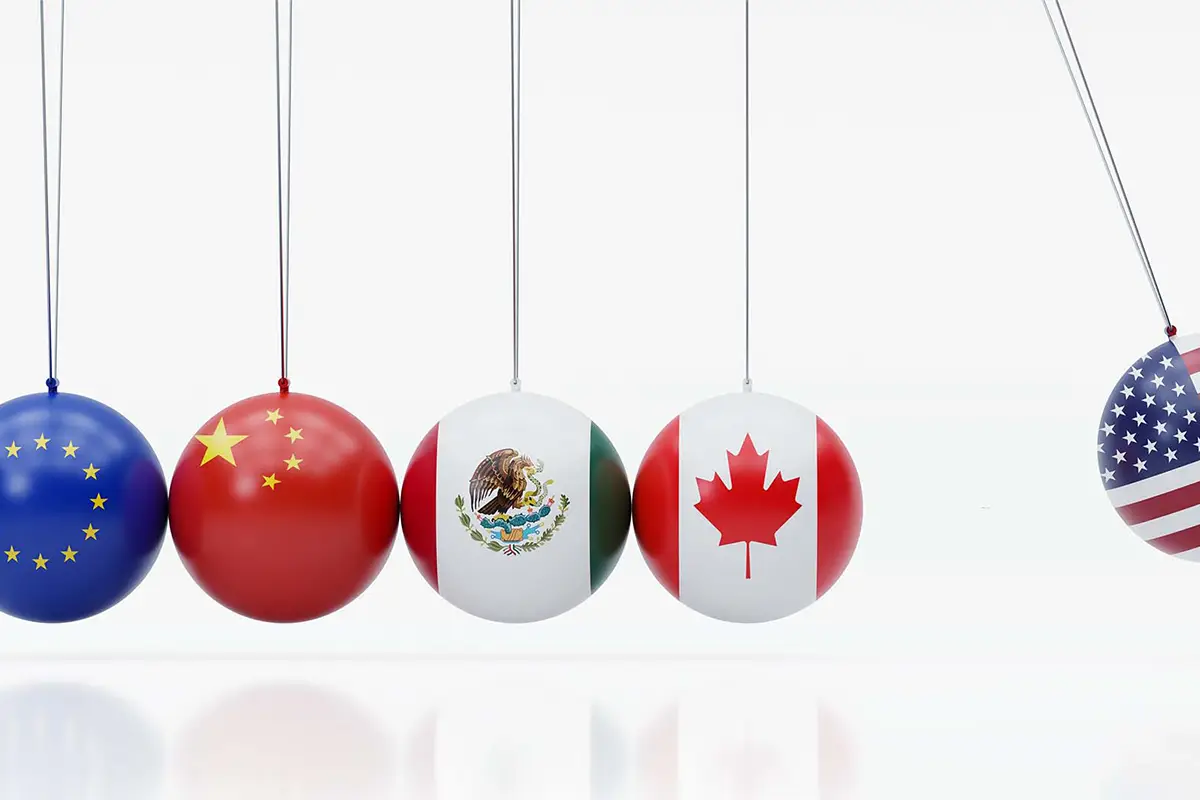
What does recent history tell us, about the potential impact of tariffs during Trump 2.0? In 2018, President Donald Trump imposed sanctions on various products using a broad range of seldom-used US trade laws, citing the need to protect America’s national security. This sparked a trade war that led to multiple disputes with China and other U.S. allies.
Trump’s reasons behind imposing tariffs
President Trump suggested that the tariffs will strengthen U.S. manufacturing, safeguard jobs, increase tax revenue, and stimulate economic growth. He has a strong history of prioritizing American trade. In the initial rounds of tariffs in 2018-2019, President Trump effectively used tariff threats to help secure the nation’s borders and respond to China’s intellectual property theft. Trade makes up approximately 67% of Canada’s GDP, 73% of Mexico’s GDP, and 37% of China’s GDP, but only 24% of the U.S. GDP. Nevertheless, in 2023, the U.S. had the world’s largest trade deficit in goods, exceeding $1 trillion.
Aluminium and steel tariffs
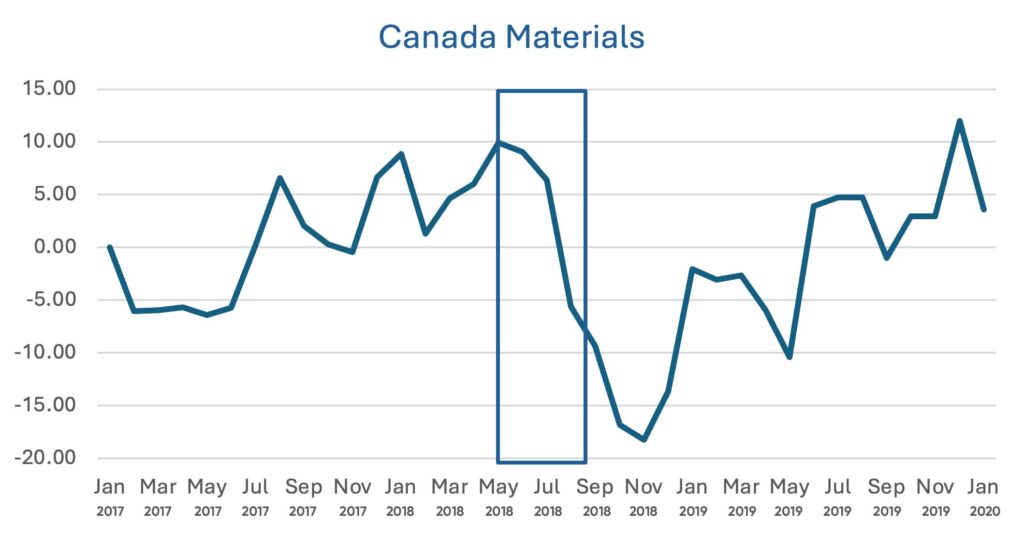
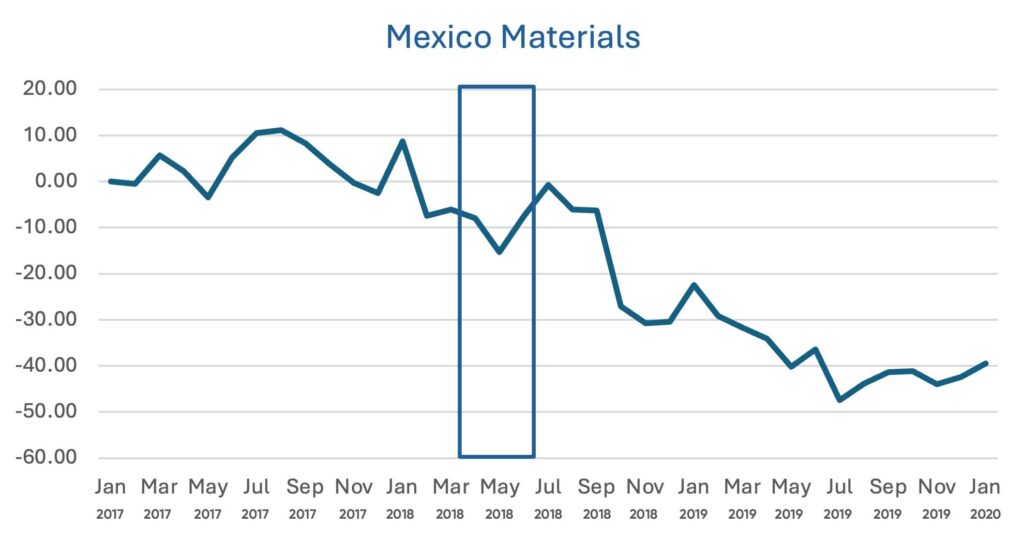
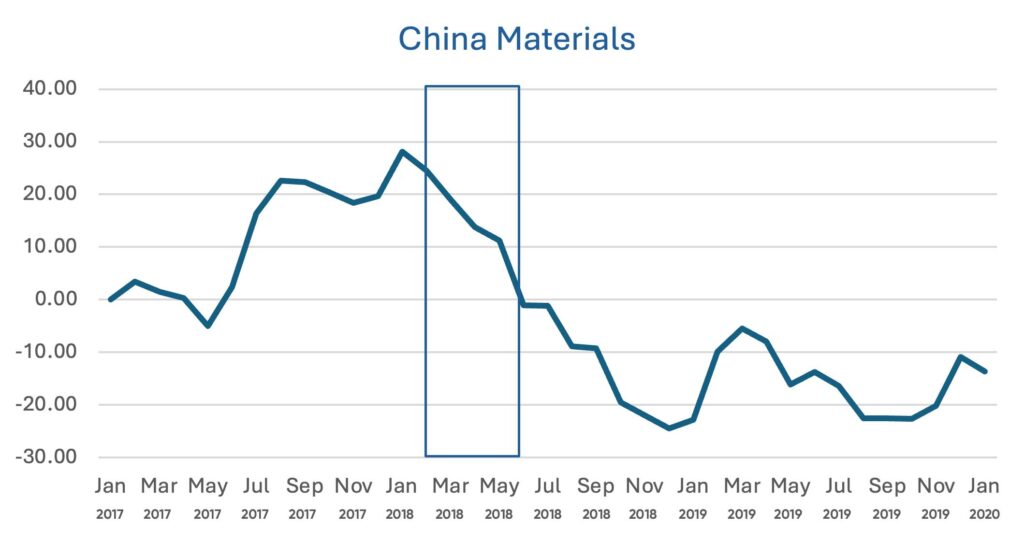
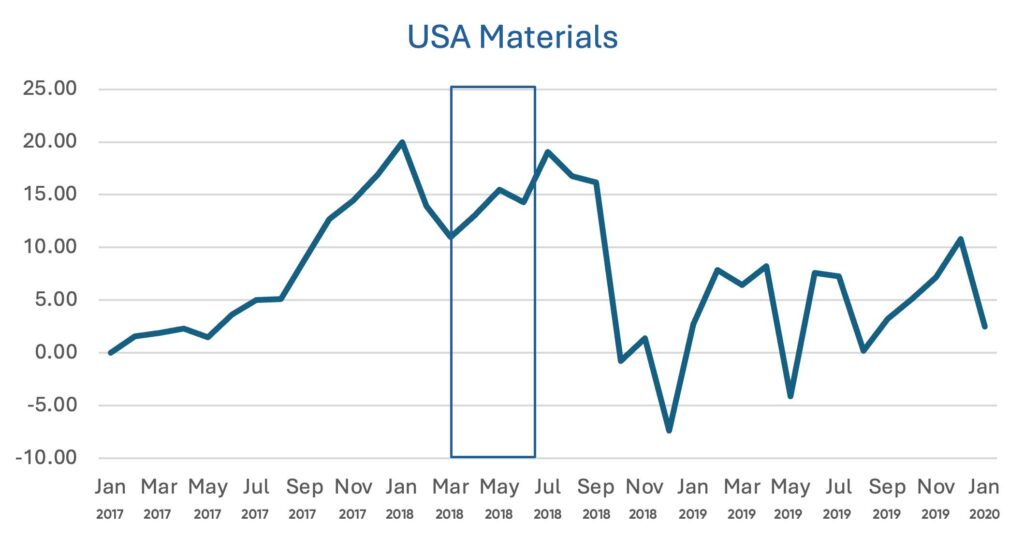
The import tariffs imposed by President Trump in 2018 had the most significant impact on the materials sectors, affecting economies such as China, Mexico, Canada, and the USA. In March 2018, he implemented 25% tariffs on steel and 10% on aluminum from most countries, including China, a move that was extended to Canada and Mexico in June. The charts below show the performance of materials sector momentum securities following the imposition of the tariffs.
Source: Confluence Style Analytics
Source: Confluence Style Analytics
Source: Confluence Style Analytics
Source: Confluence Style Analytics
Info-tech sector
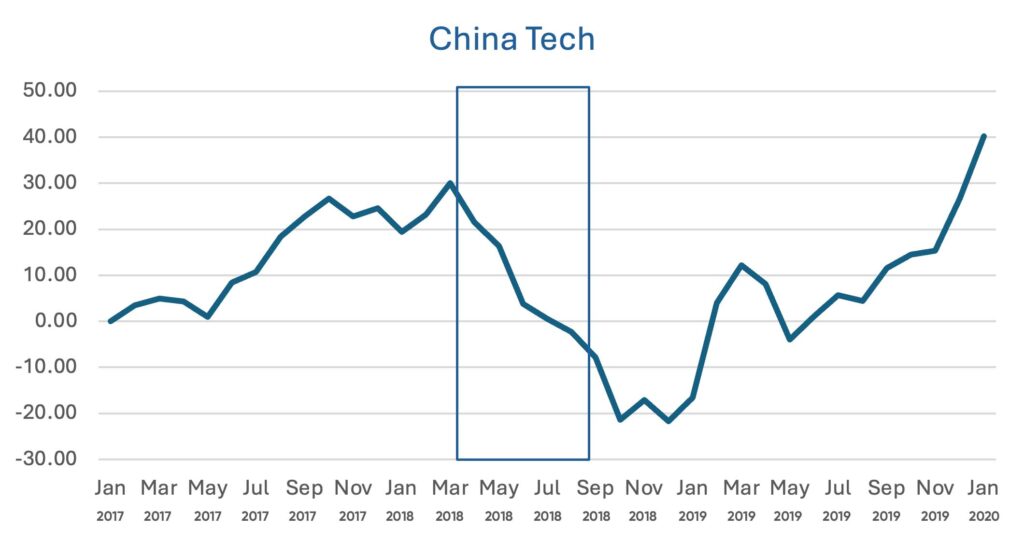
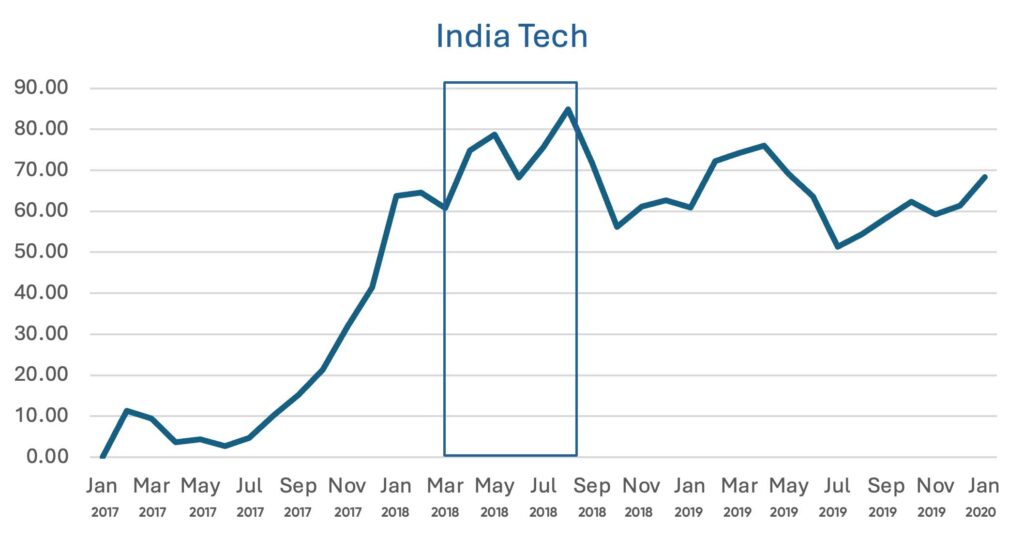
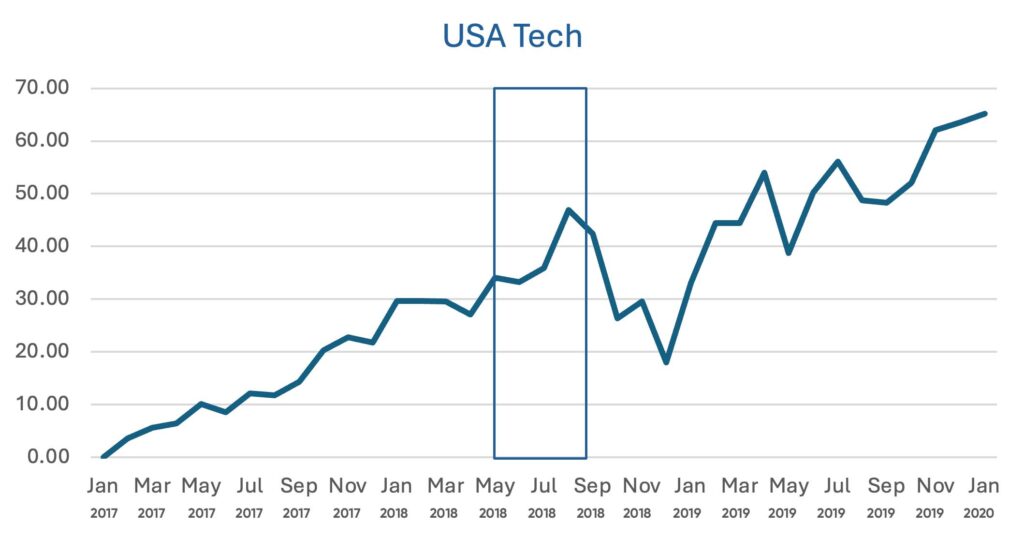
In March 2018, the United States Trade Representative released its findings on China’s acts and policies related to the tech sector restricting US commerce. In response, President Trump announced tariffs on Chinese technology and intellectual property. In July and August, the US announced tariffs impacting the annual trade of $50 billion, aiming to eliminate China’s harmful actions and policies. Amid the US-China trade war, the tech sector in India presented lucrative opportunities with trade diversions. The below chart reflects the tech sector performance of momentum securities from India and China following the imposition of the tariffs:
Source: Confluence Style Analytics
Source: Confluence Style Analytics
Source: Confluence Style Analytics
The immediate consequences of the tariffs in 2018-2019, included:
- Disruptions in the materials sector with U.S. manufacturers facing higher costs for raw materials, impacting industrial production and construction
- Incorrect Calculation of Regulatory Assets Under Management (RAUM)
- Retaliatory tariffs from China, Canada, and Mexico hurt U.S. exports, particularly in agriculture and manufacturing
- A decline in market confidence, as seen in momentum securities for materials and technology sectors, with volatility increasing amid the trade war
- Trade diversions benefiting India’s tech sector as companies sought alternatives to China’s supply chains
While the tariffs were framed as protectionist measures, they ultimately created friction in global markets, increasing costs for businesses and shifting supply chain dependencies.
What can this tell us about the potential impact of sanctions on the market during Trump 2.0?
President Trump has already begun implementing tariffs on China, while Canada and Mexico received a 30-day reprieve. In response to the U.S. tariffs, China has already implemented retaliatory tariffs ranging from 10% to 15% on select U.S. natural resources and machinery, effective February 10, 2025. Most recently, he ordered a 25% import tax on all steel and aluminium to go into effect on March 4. Based on the impact of President Trump’s previous administration, history may predict future impacts in 2025 and beyond:
- Increased market volatility: Just as in 2018, sectors that depend on global trade, manufacturing, and technology imports will face turbulence
- New supply chain disruptions: Companies that adapted post-2018 may need to realign, leading to further cost adjustments
- Domestic Economic Adjustments: U.S. industries may experience challenges and opportunities, with some sectors benefiting from reduced foreign competition while others suffer from increased production costs
- Greater geopolitical consequences: The potential for heightened global tensions could drive alternative trade partnerships and diversification in sourcing—just as India benefited from the last trade war
- Opportunities in emerging markets: As companies and investors look for non-tariffed regions, economies like India, Vietnam, and Latin America could see accelerated growth
With forecasted aggressive tariffs and trade sanctions, this second President Trump term has already started to repeat previous market shocks, reshaping investment strategies and economic policies worldwide.
History repeating?
The 2018-2019 tariff war serves as a blueprint for what is currently underway and what could come next under President Trump 2.0. While protectionist policies aim to strengthen domestic industries, they often lead to higher costs, retaliatory trade measures, and unintended market shifts.
The real winners in a renewed tariff war may not be the U.S. economy but rather alternative markets that capitalize on shifting trade routes—just as India’s tech sector surged amid U.S.-China tensions last time.
The question remains: are businesses, investors, and policymakers better prepared this time, or are we destined to relive the same cycle of economic turbulence?

Style Analytics
Style Analytics provides industry-leading, visually compelling portfolio insights, empowering asset managers to analyze factor exposures with confidence.
Reach out for a demoDisclaimer
The content provided by Confluence Technologies, Inc. is for general informational purposes only and does not constitute legal, regulatory, financial, investment, or other professional advice. It should not be relied upon as a substitute for specific advice tailored to particular circumstances. Recipients should seek guidance from appropriately qualified professionals before making any decisions based on this content.
Unless otherwise stated, Confluence Technologies, Inc. (or the relevant group entity) owns the copyright and all related intellectual property rights in this material, including but not limited to database rights, trademarks, registered trademarks, service marks, and logos.
No part of this content may be adapted, modified, reproduced, republished, uploaded, posted, broadcast, or transmitted to third parties for commercial purposes without prior written consent.
Author

About Confluence® Technologies
Confluence is a global leader in enterprise data and software solutions for regulatory, analytics, and investor communications. Our best-of-breed solutions make it easy and fast to create, share, and operationalize mission-critical reporting and actionable insights essential to the investment management industry. Trusted for over 30 years by the largest asset service providers, asset managers, asset owners, and investment consultants worldwide, our global team of regulatory and analytics experts delivers forward-looking innovations and market-leading solutions, adding efficiency, speed, and accuracy to everything we do. Headquartered in Pittsburgh, PA, with 700+ employees across North America, the United Kingdom, Europe, South Africa, and Australia, Confluence services over 1,000 clients in more than 40 countries. For more information, visit www.confluence.com.